PBS: NewsHour: Shields & Brooks on the Debt Limit Drama & Health Care Reform

Source:The New Democrat 

The whole debt limit debate in Congress was really about the 2014 mid-term congressional elections for House and Senate Republicans who want to add to their House majority and win back the Senate and not see another fight on this issue, especially if they lose. House Speaker John Boehner brought a clean debt limit bill to the House floor and told his Republican Conference to vote the way they wanted on it, because enough House Democrats will vote in favor of it anyway and he could send it to the Senate.

As far as Senate Republicans go, who are still in the minority but can block legislation from coming up for votes if they are united, Senate Minority Leader Mitch McConnell rounded up enough Republican votes to allow for the debt ceiling bill to be voted on and then told his conference to vote the way they wanted, but we are not going to block this bill and we are going to move onto other issues where we can score political points.

With the Affordable Care Act, more Americans are getting health insurance than would have if nothing was done and we still have the health care system that we had pre-2010. The progress is slower than Democrats would like, obviously, but the progress is real and Americans are starting to feel it to the point that it may not cost Senate Democrats the Senate in 2014 alone and may give them a fighting chance to hold onto the Senate if they are able to make their elections about the economy, including immigration, where they have clear advantages.

Posted in Shields & Brooks, The New Democrat | Tagged , , , , , , , , | Leave a comment

Paul Krugman: ‘Inequality, Dignity & Freedom’

paul krugman_ inequality, dignity and freedom (2014) - Google SearchSource:New York Times– left-wing columnist Paul Krugman.

Source:The New Democrat

“Now that the Congressional Budget Office has explicitly denied saying that Obamacare destroys jobs, some (though by no means all) Republicans have stopped lying about that issue and turned to a different argument… — it’s still a bad thing because, as Representative Paul Ryan puts it, they’ll lose “the dignity of work.” …
It’s all very well to talk in the abstract about the dignity of work, but to suggest that workers can have equal dignity despite huge inequality in pay is just silly. …
In fact, the people who seem least inclined to respect the efforts of ordinary workers are the winners of the wealth lottery. … And … Republican politicians. …
So what would give working Americans more dignity … despite huge income disparities? How about assuring them that the essentials — health care, opportunity for their children, a minimal income — will be there even if their boss fires them or their jobs are shipped overseas?
Think about it: Has anything done as much to enhance the dignity of American seniors, to rescue them from the penury and dependence that were once so common among the elderly, as Social Security and Medicare? Inside the Beltway, fiscal scolds have turned “entitlements” into a bad word, but it’s precisely the fact that Americans are entitled to collect Social Security and … Medicare, no questions asked, that makes these programs so empowering and liberating.
Conversely, the drive by conservatives to dismantle much of the social safety net, to replace it with minimal programs and private charity, is, in effect, an effort to strip away the dignity of lower-income workers.
And it’s … an assault on their freedom. Modern American conservatives talk a lot about freedom, and deride liberals for advocating a “nanny state.” But when it comes to Americans down on their luck, conservatives become insultingly paternalistic, as comfortable congressmen lecture struggling families on the dignity of work. And they also become advocates of highly intrusive government. …
The truth is that if you really care about the dignity and freedom of American workers, you should favor more, not fewer, entitlements, a stronger, not weaker, social safety net.
And you should, in particular, support and celebrate health reform. Never mind all those claims that Obamacare is slavery; the reality is that the Affordable Care Act will empower millions of Americans, giving them exactly the kind of dignity and freedom politicians only pretend to love.”

From The New York Times

“Nobel Prize-winning economist and New York Times Op-Ed columnist Paul Krugman discusses the history of the American “middle class,” and argues that growing income inequality may threaten its existence…
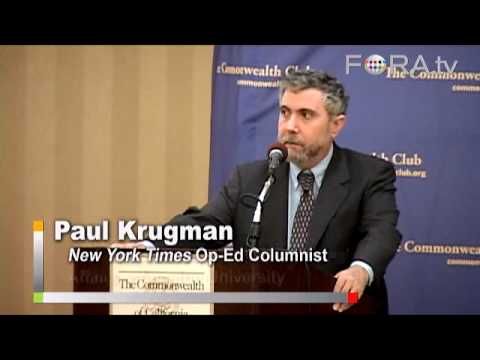
Paul Krugman - Income Inequality and the Middle ClassSource:FORA-TV– left-wing economist Paul Krugman talking about American economic history.

From FORA-TV

Just to respond to a couple of things that Paul Krugman said with regard to nothing having been done more to ensure freedom for Americans than Social Security and Medicare:

Well, actually there is, and it is called a good education. And for Americans who have that, in many cases they do not need either Social Security or Medicare even when they are eligible for it because they have their own retirement account or have managed to stay healthy long enough to be able to work as long as they want to and put money away for their children and grandchildren.

Just to make one more point about Paul Krugman’s column:

If you look at the educational levels of the wealthy, super wealthy, or just the upper middle class and then compare their education with that of people struggling in the middle class perhaps working a blue collar job or even a couple jobs just to pay their bills or you look at low-income workers, there is not contest in their education levels.

If you want to do well in America, you need to have marketable skills or talents because otherwise you will need Social Security and Medicare to help pay your bills when you are older, assuming you are not living in poverty.

The dignity of work is a good job that more than pays your bills and allows you to put money away so you can make your own health care and health insurance as well as retirement decisions> It’s not having government make these decisions for you because you do not have the money or knowledge to be able to make these decisions for yourself. True economic freedom is not worrying about paying your bills because you can afford to enjoy life and  put money away as well.

Posted in New Left, The New Democrat | Tagged , , , , , , , , , , , , , , , , , , , , , , , , | Leave a comment

Reason Magazine: Brian Doherty: Why Progressives are Attacking Libertarians so Frequently Lately

Source:The New Democrat 

To put it simply, the reason Progressives have been attacking (I guess, how about critiquing instead) Libertarians so much lately whether it be in Salon or AlterNet or even The New Republic, which is now way to the left of the great liberal magazine it use to be is that Libertarians are all about both economic and personal freedom, which scares the hell out of people who are supposed to be the Progressives today, who sound more like Socialists and at times even Communists than they do Progressives.

What are supposed to pass as today’s Progressives are those who want a superstate, not a welfare state, which is a little different, but a government so big that individualism in a lot of cases is no longer necessary because the central government will now have the authority, whether it is currently constitutional in America or not, to make many of our economic decisions for us because they would have so much of our resources that we would be dependent on them.

I only wish it would stop there, but unfortunately it gets worse because those who are supposed to be the Progressives today would outlaw many activities they see as dangerous for society that are currently legal. Certain areas of personal decision-making, such as how we get our news, what we can eat, drink, and smoke, what we can say to each other, and even to a certain extent what we can watch on TV would be regulated if they find them offensive.

I’m not attacking or critiquing Progressives. I have a certain respect for Roosevelt, Truman, and Johnson, Progressivism that is the real Progressivism, and there are actual Progressive Democrats today. Representative Henry Waxman and Senator Tom Harkin are both great examples of actual Progressives who are in Congress today. I’m talking about the far left, a real statist form of Socialism that is far out of the mainstream in American politics.

Posted in Reason, The New Democrat | Tagged , , , , , , , , , , | Leave a comment

American Enterprise: Michael R. Strain: A $4 Minimum Wage Can Get People Back to Work

Source:The New Democrat 

Sure, you could pay someone $4.00 an hour and that would encourage companies to start hiring again and they would probably hire a lot more people again, people who haven’t finished high school and are not even old enough to drive or vote. And I’m sure adults would take some of these jobs too, but not if they have bills to pay and this $4.00 hour job was their only source of income, because that wouldn’t pay the bills for them in most areas in the United States.

If people haven’t eaten in a while for whatever the reasons, you could give them cat food and as much cat food as they could eat for an indefinite amount of time. And if they were able to keep all of that cat food in their bodies and not cabinets for their cats and didn’t vomit the cat food, you could prevent them from starving as well. If someone needed to get to work and didn’t have a way of getting there by automobile, bus, or taxi and, let’s say, they live 10 miles from work, you could tell that person to wake up really early every morning and walk the whole way to work so they were able to get to work every day and not miss any work.

My whole point here is that there are good ways to solve problems, there are bad ways to solve problems, and, as in this column from the AEI today, there are ways to solve problems that may solve the intended problem but create new problems as well. The idea is to solve the problem without creating new ones, and when you are talking about creating jobs for the long-term unemployed, you want them to have jobs that pay their bills so they no longer need public assistance and not jobs that pay a little more than half the minimum wage so that they are not only in a low-income job but are also collecting a hell of a lot of public assistance and private charity just to survive.

Posted in AEI Video, The New Democrat | Tagged , , , , , , | Leave a comment

PBS NewsHour: Closing the Gap: Senator Tim Scott on Expanding Educational Opportunities

Source:The New Democrat 

If Senator Tim Scott is talking about expanding educational choice in the public school systems including charter schools, then I’m all for that as long as the Federal Government is not mandating this without the funds to pay for them. And I would also expand educational and job training opportunities for low-skilled workers and low-skilled adults who aren’t currently working so they acquire the skills to find good jobs.

If Senator Scott is saying that we should do those things plus school vouchers and mandating them from the Federal Government and taking the decision away from States and localities about whether to use taxpayer funds that would normally go to public education to pay for private schools instead, then I’m not in favor of that on the Federal level, and if States and locals want to do that, then that is their business. But for the Feds to be involved in education at all it should be in public education as a helper and funder but not as a director.

Posted in NewsHour, The New Democrat | Tagged , , , , , , , , | Leave a comment

The Fiscal Times: Mark Thoma: How Keynes Would Handle an Abnormally Slow Recovery

Source:The New Democrat 

I’m all in favor of trying to boost economic and job growth when the economy is weak with something like a new national infrastructure plan, a National Infrastructure Bank. But when you have a national debt as high as your Gross National Product, I mean 17 trillion dollars is one figure. I bet most Americans have a hard time getting their fingers around the total size of the American economy as well as national debt, and when it is that high it blows their minds. Your credit card bill is due and to keep what you need to pay back from getting even further out of hand you at least have to start paying some of that back to keep your credit from being ruined altogether.

We have a financial deficit, an infrastructure deficit, an energy deficit, a manufacturing deficit, and a tax deficit. Our corporate tax system is not competitive with a lot of the developed world. When your economy is just barely over the water, that is the perfect time to fix all of those things. But do it in a fiscally responsible way so you don’t make your current financial situation any worse than it is or it has to be and, yes, interest rates are low right now but artificially low because of the Federal Reserve decisions, not because of any real strength in the economy. So:

1. Let’s encourage more corporate and other business-related investment in the United States, including manufacturing and energy.

2. Let’s start rebuilding this country with a National Infrastructure Bank.

3. Let’s encourage more manufacturing in America and stop encouraging companies to send jobs overseas.

4. Let’s create a plan to move America toward energy independence by producing America’s energy across the board, at least in the short term.

5. And let’s have real tax reform so we can lower taxes on the middle class, which would also boost economic growth as well.

But let’s pay for all of these policies instead of adding to our national credit card.

Posted in New Left, The New Democrat | Tagged , , , , , , , | Leave a comment

AlterNet: Robert Reich: Why America Has Forgotten Its Three Biggest Economic Lessons

Source:The New Democrat

AlterNet: Opinion: Robert Reich: Why America Has Lost Its Three Biggest Economic Lessons

What Robert Reich and others on the further left of me do not understand is that when we had those huge tax rates in the United States ranging from 25 to 90 percent in the Eisenhower Administration, we had several recessions and periods of high unemployment. Anyone who remembers the 1970s, starting in let’s say 1973 with the Middle East Oil Embargo, knows that the high inflation and interest rates were part of the recession of 1974-75, which was part of what is called by economists the Great Deflation of the 1970s, a combination of both high inflation and interest rates plus a recession that made for a pretty bad economy.

But you don’t have to go as far back as the 1970s and you could leave out the other recessions of 1979-80 and 1981-82 and you could go back to the 1950s, the early fifties and the late fifties of rough periods in our economy. Recessions and high unemployment were followed by a weak recovery in the early 1960s.  Let’s also not forget that a liberal Democratic President Jack Kennedy first proposed cutting taxes in the early 1960s, which President Lyndon Johnson got through a Democratic Congress in 1964, to deal with a weak economy.

The real economic debate in the United States is not so much whether we have an income gap but really what to do about it.  Over-taxing people because you believe they are too wealthy and by doing this you will be able to generate the revenue needed so to take care of everyone else will not accomplish this because the people who are doing very well will just move that money to other places, like countries that either have lower taxes on the wealthy or do not tax bank accounts.

What we need to do is to encourage people who are already very successful to continue to be very successful and to regulate them in areas that affect consumers and workers. They should not be making their money by punishing those groups but by empowering people who are barely in the middle and on the lower end of the economic scale to be able to do better by improving their skills so they can be productive enough to get the types of jobs (or open a business) that could generate sufficient income to meet their families’ needs.

You don’t get there by saying that some people have too much money and others have barely anything and the solution is to over-tax the haves to care for everyone else. First, government will never see that money because it will be moved elsewhere, with a loss to the country of important revenue. Second, you are now sending the message that the highly successful should not be rewarded.

Posted in New Left, The New Democrat | Tagged , , , , , , , , , , , , , , , , , , | Leave a comment

Free Speech TV: Video: The Big Picture With Thom Hartmann: Richard Wolff What to do when Capitalism Fails

The New Democrat

Didn’t catch the part about what Professor Richard Wolff would do when capitalism failed. He just said how he believed it would fail and why it would fail but not what would happen next. I could give you what he’s said in the past about what should replace capitalism, at least in its current form in America.

And he’s argued in the past for simply replacing capitalism with a Marxist economic system of state ownership across the board, and a few months ago I read a column of his arguing for economic cooperatives, which is a more Socialist form of capitalism, where the employees themselves would each own a share of the business at which they work, not government, which is different. I believe this is an excellent alternative to the corporate centralized model as long as it is not mandated by government but where management or individuals make the decision to cooperate themselves, for lack of a better word, but I didn’t hear him call for these things in this video.

Posted in The New Democrat, Thom Hartmann | Tagged , , , , , , | Leave a comment

Russia Today: Thom Hartmann & Tim Cavanaugh: When Conservatives Embraced Big Government

Source:The New Democrat 

What Thom Hartmann doesn’t mention is that a lot of those Federal jobs were created in the Reagan Administration in the U.S. Department of Defense and a large number in the private defense industry and most of that money for the DoD was put on the national debt card. Ronald Reagan might have been an economic conservative but he sure as hell wasn’t a fiscal conservative, taking a budget deficit of roughly $40 billion in 1980 up to 200 by the time he left office in January 1989 and adding something like $4 trillion to the debt.

So President Reagan was not hiring all of these social workers or increasing the size of the U.S. Department of Education or the number of employees at the Social Security Administration, Medicare, and other social insurance agencies. He was expanding the size of the national security state, not the welfare state, because he wanted the Cold War with Russia to end, which was a great thing. But the country paid a hell of a price for that with the stock market crash of 1987 and the recession of 1990-91.

Posted in The New Democrat, Thom Hartmann | Tagged , , , , , , , , , , , , , , , , , , , , | Leave a comment

30 For 30: Video: Straight Outta LA: The Story of the Los Angeles Raiders

Derik Schneider on Google+

The truth is that had Al Davis and his team marketed his Raiders franchise in Los Angeles as the Dodgers and Lakers are marketed in Los Angeles, the Raiders would probably still be in LA today. Instead Mr. Davis believed that people would automatically just show up to see a good football team every week. The fan interest would have been there and the crowds would have been there and there would have been enough interest for Los Angeles to give the Raiders franchise what it needed to be successful in Los Angeles, whether that was new renovations to the LA Memorial Coliseum or a new stadium altogether.

When I think of the Los Angeles Raiders who were in Los Angeles from 1982 to 1994 before moving back to Oakland, I think of both good and bad and probably more bad then good actually, as my first paragraph, I believe, points out, but to be positive and factual, the LA Raiders were very good in the 1980s. They won two Super Bowls in 1980 and 1983 and probably should have won a couple more in 1982 and 1984, but the 1983 Raiders were one of the best and most dominant Super Bowl champions of all time.

But the story doesn’t end there, because again, they were there from 1982 to 1994 and are not still there today. Also there’s a lot of what could have been, had Al Davis basically not ruined running back Marcus Allen’s career and not cost him at least 4 to 6 years. Marcus was the best all-around running back of his era, at least post Walter Payton, and the mistake of Al Davis telling his coaching staff not to play Marcus because he believed Marcus became bigger than the Raiders franchise itself.

But instead they traded for running back Bo Jackson because of baseball. He was never more than a part-time player for the Raiders and only played four seasons because of the hip injury. Instead of trading for Bo, they should have invested the money into getting a Pro Bowl-caliber quarterback to take over for Jim Plunkett or again trade for Bo but not reduce the role of Marcus in the backfield. They should have gone to a two-back full-time set and become a run-oriented football team with Marcus and Bo and 2,000 yard rushers year after year on the same team. How much better would their vertical spread passing game had been with that running game.

To sum up, the Los Angeles Raiders were a team of underachievers, not just some of the players but the franchise as a whole, and again we are talking about a two-time Super Bowl champion franchise, but they could have done so much more and should have been the team of the NFL of the 1980s to take over for the Pittsburgh Steelers from the 1970s because of the talent they had, the market they played in, and the man at the top in Al Davis.

Bad Boys of LA

Bad Boys of LA

Posted in NFL Films | Tagged , , , , , | Leave a comment