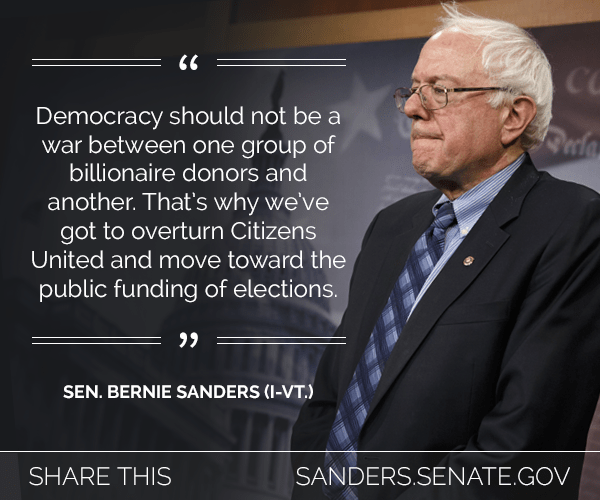
The Hill: Congress: Keith Laing: Senator Bernie Sanders: $1T Infrastructure Bill Would Be Cheaper Than Iraq War

Source:The Hill

Bernie Sanders wouldn’t be Bernie Sanders if we wasn’t proposing things like a trillion-dollars in infrastructure investment to rebuild America. And I agree with him as far as the amount of money that we should invest to rebuild this country and how that money would be spent. Which would to prioritize much needed infrastructure projects around the country and repairs that must be done to avoid future accidents and to put as many Americans back to work as possible.

The only areas where I disagree with Senator Sanders is how to finance this. What the Senator is talking about is funding this investment through the U.S. Government and taxing corporations’s oversees profits and eliminating tax breaks that they get at home. That part I don’t disagree with, except I would use that revenue differently. But the process is where I have the main problem, because what he’s talking about needs to go through a broader tax reform package that needs to be worked out in Congress between the House and Senate, with President Obama involved. Whatever tax reform that the President and Congress work out would probably a trillion-dollars by itself.

Tax reform and infrastructure are two different issues that should be treated separately. You could invest a trillion-dollars in infrastructure, pay for it without borrowing and not need to do tax reform to get it done. And do tax reform as a different bill. Both are important issues that have to be dealt with to get the type of investment in America that we have to have to make our economy as strong as possible. You could tax oil, you could tax gas, you could raise fees, you could tax things that aren’t very healthy for society. Like tobacco, alcohol and marijuana if it ever legalized federally. And you could bring in the private sector to invest in our infrastructure.

What we could do is to set up a National Infrastructure Bank that would work independent of the U.S. Government, but lets say owned by them. Similar to the Federal Reserve or Amtrak, that would be non-profit. And use this first trillion-dollars to get the NIB up in running and to prioritize infrastructure projects around the country. Consulting the private sector, state and local governments, as well as the Feds. And bringing in private investors to finance these projects around the country. But Senator Sanders bill is an excellent start to a critical issue for the country that has to be addressed.

Posted in Originals, The Hill | Tagged , , , , , , , , , , , , , , , , , , , , , , , , , , | Leave a comment

The American Prospect: Paul Starr: The Crash of The New Republic

Conferencia de Chris Hughes, Co-Fundador de Facebook en Ecuador #fbgye10
The American Prospect

I would put it differently and if I was writing for The American Prospect, well if I was writing for The American Prospect, they probably wouldn’t of published what I have to say about The New Republic, because I wasn’t backing the party line. But for the sake of this piece had I wrote this article at The Prospect about The New Republic I would’ve put it differently. I probably would’ve called it The Death of The New Republic: How Chris Hughes Killed a Great Liberal Magazine. And he did it a couple of ways.

Chris Hughes took a great center-left liberal magazine, not a far-left more social democratic oriented magazine like The Nation or The New Republic and turned TNR into The Nation or The Prospect ideologically. You read TNR today and it is very similar to Nation or Prospect or the AlterNet, TruthOut, Salon or any other far-left publication that struggles just to stay in business today. Because they don’t have any advertising revenue. Because they are anti-business if not anti-private enterprise all together.

When Mike Kinsley was running TNR they were still that great center-left magazine. That had solid suspicions about big government in people’s economic and personal lives. Today’s TNR now not only supports a Scandinavian social democratic high taxed welfare state to manage people’s economic affairs for them. But backs Mike Bloomberg’s nanny state and would like to regulate how Americans can eat an drink.The New Republic might not become like The Prospect or Nation financially. Because they do have wealthy backers and are entertainment and tabloid driven with what they want to cover. So that alone might keep them in business. But The Liberal Republic is gone.

The other issue has to do with Chris Hughes himself. He’s a businessman first and comes from the OMG awesome entertainment universe and politics and current affairs is not his meat and potatoes. He goes where the money is and that is probably where TNR is headed with a few political writers left over to tell people what the far-left is thinking. And why middle class Americans are under-taxed and that the Federal Government is too small, states and local governments, as well as individuals have too much power and can’t be trusted and you need a bigger government to take care of them. Which is what you get from The Prospect, The Nation and Salon today.

Posted in New Left, Originals | Tagged , , , , , , , , , , , | 1 Comment

Brookings Institution: Fred Dews: ‘An Economic Agenda For America-A Conversation with U.S. Senator Bernie Sanders’

An Economic Agenda for America_ A Conversation with Bernie Sanders

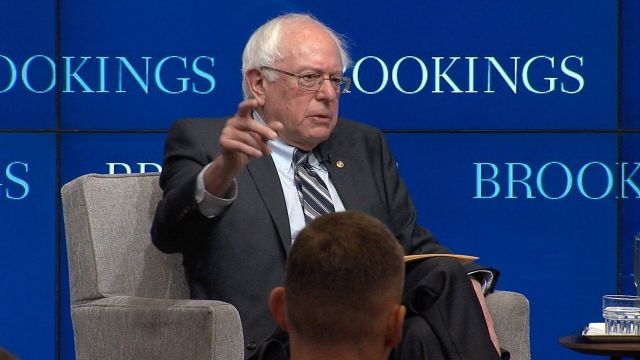
Source:Brookings Institution– U.S. Senator Bernie Sanders (Democratic Socialist, Socialist Republic of Vermont) at Brookings in Washington in February.

“On February 9, the Center for Effective Public Management at Brookings hosted Senator Sanders, the ranking member of the Senate Budget Committee, to discuss his economic policy ideas to spur growth and rebuild America’s middle class.”

From Brookings Institution

Senator Bernie Sanders

Source:Brookings Institution– U.S. Senator Bernie Sanders (Democratic Socialist, Socialist Republic of Vermont)

This blog blogs about socialism a lot and for good reasons. One socialism is about as popular in America as it has been since the 1920s or so. Another is that more Americans are now learning about what it actually is and not how hyper-partisans on the Right like to talk about it and call people Socialists like they were calling them bastards or something. Socialist is no longer seen as an insult or a four-letter word by a lot of Americans now. Which is why you now see Americans are further to the Left and even far-left of center-left Liberal Democrats such as myself embrace and own the label. Senator Bernie Sanders being the perfect example of that. Even if there are still come closeted Socialists trapped in the closet at MSNBC and the new The New Republic.

I’m not a Socialist and neither is this blog as we’ve made clear for several years now. But there is a type of socialism that I respect and it is the democratic form of it. As Senator Sanders said at Brookings yesterday he believes in capitalism and private enterprise and that it has done a lot of good for America. With competition and the development and creation of all sorts of products that we all use. But that he also believes that all Americans should have the basic necessities in life. And that is where government comes in to see that no one is left behind . The difference being between a Democratic Socialist like Bernie Sanders and a Marxist like Fidel Castro to use as an example. Where the Marxist believes that the job of government is essentially to take care of everyone in society. And that people can’t be trusted with freedom over their own lives.

If you listened to Senator Sanders at Brookings yesterday his speech and interview with E.J. Dionne who I would label as a FDR classical Progressive and not a Liberal, which is different, not once did you hear Senator Sanders talk about nationalizing this industry or that industry. Other than health insurance and wanting to make Medicare the only health insurer in the country. But you also hear in that speech and interview why he’s both a great ideologue and legislature. He said he would be opened to the public option for Medicare and making everyone eligible for it and not just seniors. And leaving in the private health insurance industry as well. What Senator Sanders talked about had to do with infrastructure investment, college affordability for everyone and tax reform so the rich pay what he views as their fair share.

Anyone who believes the auto, banking and even media and internet should be nationalized in America and we still have a few Marxists and leftist fascists on the Left, doesn’t have much of a political future in America as a candidate or politician. Unless you keep your politics to yourself and try to sound much more moderate. The type of socialism that can sell in America even outside of New England the Northwest and San Francisco is the social democratic form of it. Multi-party, private enterprise, mixed in with big government in the form of a welfare state to provide people with the basic necessities that we need to live well and healthy. Like education, health care, health insurance, retirement, to use as example. While the private enterprise provides everything else, especially in areas where you must have competition in order for those services to be as strong as they are. Transportation, food, media, technology, entertainment to use as examples. Socialism mixed in with private enterprise.

Posted in Brookings, Originals | Tagged , , , , , , , , , , , , , , , , , , , , , | Leave a comment

CBS News: ‘Person to Person Classic: JFK & Jacqueline (1953)’

Person To Person Classic_ JFK and Jacqueline - Google Search

Source:CBS News– U.S. Senator John F. Kennedy (Democrat, Massachusetts) and his wife Jacqueline, on CBS’s Person To Person in 1953.

“Sen. John F. Kennedy and his wife, Jacqueline, were interviewed by Edward R. Murrow in their Boston apartment one month after they were married in 1953. The new bride was taken aback when Murrow asked her what requires more diplomacy — her old job as a reporter or being married.”

From CBS News

“Sen. John F. Kennedy and his wife, Jacqueline, were interviewed by Edwards R. Murrow in their Boston apartment one month after they were married in 1953. The new bride was taken aback when Murrow asked her what requires more diplomacy–her old job as a reporter, or being married. CBS News is bringing back an icon – “Person to Person” with Charlie Rose and Lara Logan airs Wednesday, Feb. 8 at 8 p.m. ET/PT.”

Person to Person classic_ JFK and Jacqueline

Source:CBS News– U.S. Senator John F. Kennedy (Democrat, Massachusetts) and his wife Jacqueline, on CBS’s Person To Person in 1953.

From CBS News

The Kennedy’s had just been married by this point in 1953. John Kennedy was in his first year in the U.S. Senate. He was just a freshman senator at this point, serving in a Republican Congress, with Republican President Dwight Eisenhower. And Jackie was essentially a rookie at being a politician’s wife.

This is going to sound hard, but Jack Kennedy was politically smart enough to know that he wasn’t going to get elected President as a bachelor. Especially as a bachelor with a reputation as a playboy. That is where Jackie comes in to make it look like Jack has settled down with one woman and was ready to start a family.

I’m not saying Jack didn’t love Jackie, but that was not his primary motive for marrying her. He wanted to run for and be elected President in 1960 and the way to do that back then and still today is at the very least be seen as a family man. With a wife and kids and be perceived as loving both.

Posted in Classic News, Originals | Tagged , , , , , , , , , , , , , , , , , , , | Leave a comment

The Diplomat: Francis P. Sempa: The Geopolitics of The Vietnam War

“On April 30, 1975, as North Vietnamese troops captured Saigon, helicopters rescued the last remaining Americans from the roof of their embassy in South Vietnam – an unforgettable manifestation of the ignominious U.S. defeat in the war in Southeast Asia that cost more than 58,000 American lives. Between 1962 and 1975, James Burnham frequently devoted his fortnightly column in National Review to a geopolitical analysis of the war in the context of the larger struggle between the West and the Soviet Union. Looking back at those columns forty years after the end of the war makes for interesting reading because Burnham, more so than any other contemporary observer of the war, mostly got things right.

Born in Chicago in 1905, Burnham, the son of a railroad executive, studied at Princeton and Oxford in the 1920s, taught at New York University from the 1930s (when he temporarily embraced Marxism) to the early 1950s, worked as an analyst for the OSS during World War II and as a consultant to the CIA in the early Cold War years, authored 12 books, and served as a columnist and editor at National Review until sidelined by a stroke in 1978. He died at the age of 82 in 1987.

In his best-known books – The Managerial Revolution, The Struggle for the World, The Coming Defeat of Communism, Containment or Liberation?, and Suicide of the West – Burnham portrayed the U.S.-Soviet struggle as a zero-sum contest for world supremacy, similar to the first two world wars of the 20th century. In fact, in the first sentence of The Struggle for the World Burnham called the U.S.-Soviet conflict “The Third World War,” which later became the original title of the National Review column that he began writing in September 1955. In 1970, he changed the title of his column to “The Protracted Conflict.”

Burnham understood that because of the unprecedented destructive power of atomic weapons, the Third World War probably would not be waged by direct mass armed clashes between U.S. and Soviet military forces in the principal geographic theaters of Europe and the Far East, but instead would likely be fought in peripheral regions and involve proxy forces of one or the other contestant. Indeed, one of his main criticisms of the U.S. policy of containment was that it failed to address indirect political and military aggression committed by Soviet proxies in the less-developed world – the precise challenge faced by the U.S. in the Vietnam War.”

Source:The Diplomat

I think the lessons of the Vietnam War are obvious. Don’t engage in a war you’re not prepared to or will do what it takes to win. It’s the Old Colin Powell doctrine of you go in with full force or you don’t go in. I’m paraphrasing there, but that is very close. So that would be one lesson, but another one would be don’t try to do for another country what they aren’t willing to do for themselves. Don’t fight other people’s wars especially when they aren’t willing to fight for themselves. The only player in the Vietnam War that was prepared to win was what use to be North Vietnam. The South was corrupt and expected America to win the war for them.

America took a half-assed approach to the Vietnam War. President Lyndon Johnson especially was more interested in looking tough on communism and not having the Right on his back when it came to foreign policy and national security. So he went in to Vietnam with bombs and a lot of personal and we took a lot of casualties, but since he was also playing politics with the war knew that there were only so many casualties that Americans were willing to take especially for fighting someone else’s war. And didn’t go into Vietnam strong enough to actually defeat the Communists and conserve the country for the Democratic but corrupt South.

The lessons from the Vietnam War are the same for the Afghan War and the War in Iraq that America was also involved in. That you can’t fight someone else’s war and expect to win when they are willing to fight for themselves. And hopefully the campaign to destroy to destroy ISIS won’t have the same lesson. That Saudi Arabia, Turkey, Iraq and Jordan, the Syrian rebels will step up to the plate and do what they have to defeat ISIS themselves with America’s help. Because Americans won’t be willing and are unable to win a war for someone else at this point that they aren’t willing to win themselves.

Posted in Foreign Affairs, Originals | Tagged , , , , , , , , , , , , , , , , , , , , , , , | Leave a comment

The Federalist : David Corbin & Matt Parks: Liberty and The Bill of Rights

Source:The Federalist

In that entire piece by David Corbin and Matt Parks I found one thing that I agree with them on. Having to do with two of our constitutional rights that have been weaken since the so-called War on Terror was declared by President Bush in 2001. The First Amendment dealing with Freedom of Press, which is critical in any liberal democracy. And the Fourth Amendment which protects our Right to Privacy and perhaps our Fifth Amendment which protects our property rights. All of these rights are critical in any liberal democracy. But since the declaration of the War on Terror and the Bush Administration and Obama Administration has been so intelligence hungry and believe they can at the very least stretch our constitutional rights to protect our security.

With the Bush Administration it was Judy Miller in 2002-03 and believe another reporter from The New York Times. And the Bush Administration believing these reporters had information about suspected terrorists that they weren’t releasing and threatened them with prison time if they didn’t give up their sources and information. The Obama Administration had similar stories involving Fox News and the AP in the last few years. The Neoconservatives have won the War on Terror at least the debate inside of the U.S. Government about what is more important in America. Our security or our liberty and security has been winning ever since 2001. And we had a neoconservative Republican Administration that enforced their neoconservative War on Terror from 2001-09. And now a progressive Democratic Administration conducting the same war with the same policies as the last.

As the great libertarian philosopher Milton Friedman who preferred to be viewed as a Liberal once said, you can’t have security without liberty. And I would add and vice-versa that you have to have both. If you’re not secure you don’t have freedom. But without liberty you might be protected from terrorists, foreign invaders and domestic criminals, but now you have to worry about your own government and what they might do to you. Because you don’t have liberty and a basic set of constitutional rights to protect you. Because now you live in a police state. You live in Soviet Russia and perhaps even Putin Russia, or Syria or some other hell hole on Earth like that. Which is not what America is about and perhaps what our last two president’s don’t understand.

Posted in New Right, Originals | Tagged , , , , , , , , , , , , , , | Leave a comment

The New Republic: Elizabeth Stoker Bruenig: The Economist Magazine is Wrong About Welfare’s Impact on Family

Source:The New Republic

As far as disability insurance, if you are physically and mentally able to working, meaning you don’t suffer from some physical or mental condition that makes it hard if not impossible for you to work full-time, you aren’t eligible for disability insurance. Lacking skills and education for you to be able to get yourself a good full-time job or a part-time job that pays very well like being an airline pilot, to use as an example is not an excuse not work or not to work full-time. It simply means you are uneducated or are low-skilled. Which can simply can be fixed education and job training. Unless you are learning disabled and aren’t able to get the skills necessary to support yourself with a good job.

Which means for people in poverty who are low-skilled or the long-term unemployed who do have an education, but perhaps had a job that no longer exists and are now unemployed or working part-time for a lot less money than they use to, disability insurance is not the answer for them. Because they aren’t eligible for it, again to take the low-skilled worker to use as an example unless they are learning disabled. What we should be doing for these workers is putting back to school to finish and further their education that government would finance for them. As well as encourage economic development in their communities and that is where infrastructure investment comes in.

This blog made this point several times yesterday and for very good reason. Infrastructure, education and job training solves a lot of our economic problems in America. I would add economic incentives to business’s to invest in underserved areas and incentives to employers to train their low-skilled workers so they can move up in their companies would also increase wages and create jobs in this country. Because now people who were either unemployed and on Welfare before or working a low-skilled low-income job can now get themselves a good job. And not longer need public assistance at all to support themselves.

Posted in Originals, TNR | Tagged , , , , , , , , , , , , , , , , , | Leave a comment

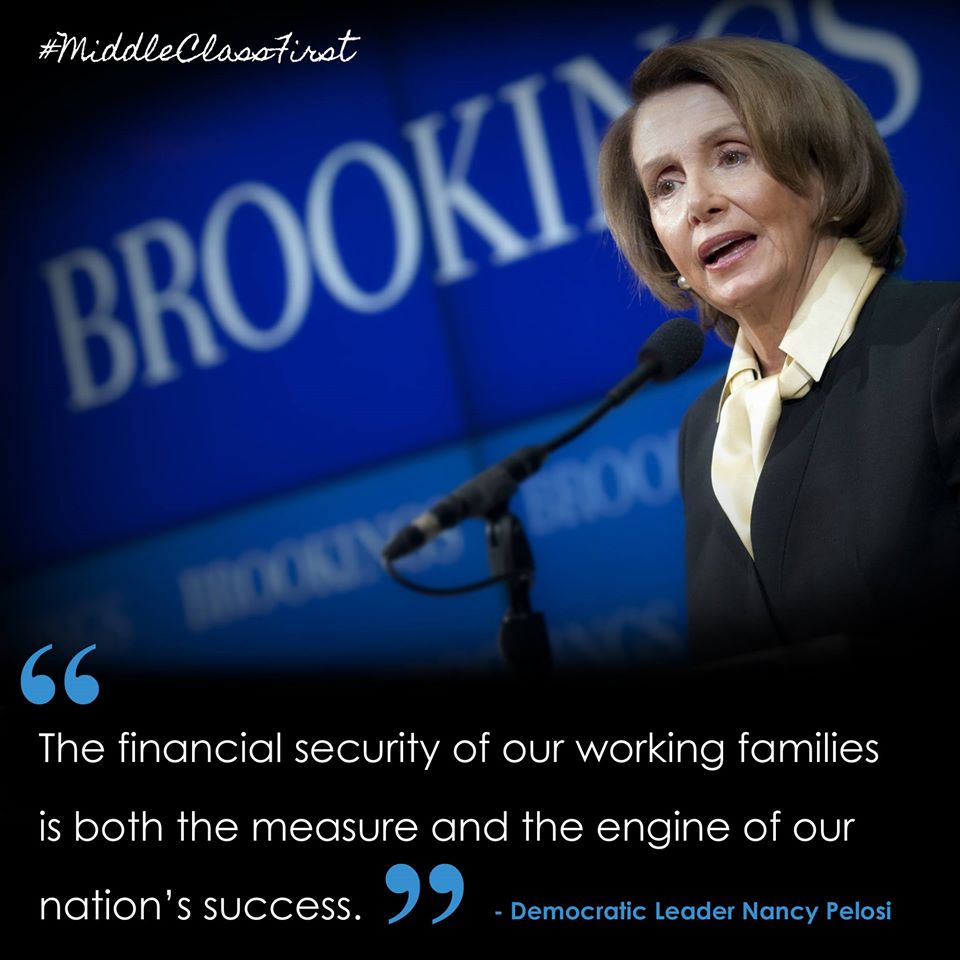
Brookings Institution: Blog: E.J. Dionne: A Conversation With House Minority Leader Nancy Pelosi: Strengthening The Financial Security of America’s Working Families

Leader Nancy Pelosi
Brookings Institution: Blog: E.J. Dionne: A Conversation With House Minority Leader Nancy Pelosi: Strengthening The Financial Security of America’s Working Families

Infrastructure investment, a national energy policy, education and job training for our low-skilled adults and low-income students, immigration reform and expanding trade to sell more American products oversees as they are built in this country, this is how you not only increase economic security for middle class Americans, but also expand the middle class in America. Educating Americans and putting them to work with good jobs that not only allows for them to pay their bills, but put money away and joy life in America.

You can talk about all sorts of government social programs to help people in poverty, but without a strong and expanding American middle class who are the real job creators in America because of the economic growth that they drive with their consumer spending, you won’t have the resources needed to pay for those social programs that you want. You can only tax so much and tax people who have money to tax. The larger the middle and even upper classes in America that you have, the more people with more money you have to do the things that we need government to do.

Infrastructure, energy, immigration, education and job training for our low-skilled adult population so they can get themselves good jobs that puts them in the middle class and even upper middle class, education reform so low-income students aren’t trapped in failing schools simply because of their zip code, that is you expand and strengthen the middle class in America. By freeing people up to be free and live their American dream and not need government to take care of them. This is the economic agenda that President Obama has pushed and that Leader Pelosi and her House Democratic Caucus should back as well. And a lot of them already do.

Posted in Economy | Tagged , , , , , , , , , , , , , | 1 Comment

The Week: Opinion- Jeff Spross: ‘President Obama’s Middle-Out Economics is Good, Bottom-Up Economics is Better’


74618

Source:The Week– A homeless person in need of a hand up 

Source: The Week: Opinion- Jeff Spross: Middle-Out Economics is Good, Bottom-Up Economics is Better

I have several questions that I would ask Jeff Spross. Which is why can’t you do both? Why can’t you have policies that improve the middle class in America so their wages go up and they can get better jobs and also assist the poor working or otherwise so they can get good jobs and leave poverty? And then I would ask how does he judge how safety net programs have cut poverty the last fifty-years.

Does Jeff Spross do that by saying that if you add up all the social insurance programs that one receives in cash dollars, they are technically not living in poverty anymore. When you add up their Welfare if they aren’t working, Medicaid, Public Housing, Food Assistance etc in dollars. Or does he measure reductions in poverty by the numbers of people who are now in the middle class with good jobs and not needing public assistance at all to pay their bills.

The fact is public assistance programs and I’m not talking about Social Security and Medicare, but anti-poverty assistance for non-retired adults and seniors in America are only for people whose income is under a certain level. They are for people who do not earn enough money to take care of themselves. And because of that they are eligible for Medicaid, Food Assistance, Public Housing the Earned Income Tax Credit if they are working, but have a low-income job. So if you need these programs or any of them, you are in poverty by definition. Because you don’t earn enough money to live out of poverty on your own.

And then another question I would have for Jeff Spross. What is wrong with encouraging work, which are what work requirements are about. What is he worried about, that low-skilled unemployed adults will get jobs. Or finish their education as well and get themselves a good job and no longer need public assistance. You don’t judge the success of anti-poverty programs by the number of people who need them. Meaning the more people who need public assistance, the more successful the program is. You judge these programs especially as they relate to education and job training for low-skilled and medium-skilled adults, by the number of people who don’t need them. Meaning the fewer people who need them, the better the program.

You judge public assistance by how many people are able to leave public assistance and poverty all together and now have a good job and are able to take care of themselves. Because now they have the skills and education needed to get themselves a good job that allows for them to support themselves and their families and no longer need public assistance at all. And the fact is we need to expand as well as empower the middle class in America. Because they are the people who drive economic and job growth in America. The real job creators with their spending on their basic and recreational needs. And education and job training and things like infrastructure and energy investment are how you drive down poverty, expand and empower the middle class in America.
PBS NewsHour: Top-Down Or Middle-Out? Debating The Key to Economic Growth

Posted in Economy | Tagged , , , , , , , , , , , , , , | 1 Comment

AEI Ideas: James Pethokoukis- Reward Work

Source:AEI Ideas

I like James Pethokoukis ideas that he listed as far as not only the Earned Income Tax Credit which along with Welfare to Work are two of the best anti-poverty programs ever created, but also as far as expanding the EITC for low-income workers. I would do that and add things like health insurance, education, job training, savings, retirement and even housing to the EITC. So these workers could actually put some money away and finish their education so they can leave their low-income low-benefit job and get themselves a good job. And leave poverty for the middle class.

If you want fewer unemployed adults in America whether they are educated or not and at least since the Great Recession there’s a mixture of both types of unemployed worker, working simply has to pay more than not working. Which is the whole point of the EITC. Money that low-income workers get back so they don’t have to pay federal income taxes. So that means increasing the minimum wage to the point that a minimum wage worker makes more money and earns that money, than someone not working at all and collecting Welfare Insurance. Because they simply do not have enough skills to get a good job.

So minimum wage 10-12 buck and hour with a thirty-percent tax break for employers. And index the minimum wage for inflation so it keeps up with inflation. And apply today’s federal minimum wage of $7.25 an hour to people on Welfare and index that for inflation as well. So the person on Welfare even if they have kids would get the message that they could get more money working than not working. As well as get assistance in order to finish their education and get themselves a good job. And be able to leave public assistance all together.
Paul Baumbach: Earned Income Tax Credit

Posted in AEI Video, Originals | Tagged , , , , , , , | Leave a comment